Building Skills in the Consumer-Directed Care Workforce
Findings from an Evaluation of the Massachusetts Home Care Training Benefit Personal Care Attendants Training Program

Key Takeaways
- The 1199SEIU Training and Employment Funds sponsors the “Massachusetts Home Care Training Benefit Personal Care Attendants Training Program,” a consumer-directed training program that provides personal care attendants (PCA) with 25 hours of training to strengthen their knowledge and skills.
- Participants gain condition-specific expertise in areas such as dementia care to better support care recipients and help them remain in their homes.
- The first 200 PCAs who complete the program are eligible for a $1,000 stipend. Although PCAs reported that the stipend was beneficial, most said they would have taken the training regardless.
- Participants reported high satisfaction with the training and identified three topics as most relevant to their work:
- Adult first aid, cardiopulmonary resuscitation (CPR), and automated external defibrillation (AED)
- Nutrition and diabetes
- Communication and boundary setting
- The program increased PCAs’ understanding of their role and job satisfaction, strengthened their confidence in their caregiving skills, led to perceived improvements in the quality of care provided to care recipients, and provided practical strategies they could use on the job. PCAs who participated in the training are likely to continue as a PCA in the next year and to advance their career as a caregiver.
Background
The 1199SEIU Training and Employment Funds in Massachusetts offers free training workshops for personal care attendants (PCA) with at least one year of experience in consumer-directed care. The primary goals of the workshops are to strengthen PCAs’ skills, improve their job satisfaction, and enhance the quality of care consumers receive.
The LeadingAge LTSS Center @UMass Boston evaluated the program to assess:
- Trainee participation and experiences.
- Implementation challenges.
- Short-term outcomes for PCAs and the individuals they support.
The evaluation included a survey and interviews with participants in the program’s first cohort (July 2024 – June 2025) who received a $1,000 stipend upon completing the training. Of the 179 English-proficient and Spanish-speaking participants, 54 PCAs completed the survey, yielding a 30% response rate.
Training Program Description
Who are Personal Care Attendants in Consumer-Directed Care?
PCAs in consumer-directed programs are paid caregivers who are directly recruited, hired, managed, and, if necessary, dismissed by the individuals receiving services. PCAs provide non-medical support, including assistance with activities of daily living and instrumental activities of daily living. Care recipients can choose their caregivers, and in certain states and circumstances, family members can serve as paid caregivers.
Participants in the Massachusetts Home Care Training Benefit Personal Care Attendants Training Program include PCAs who care for family members or friends, as well as those who didn’t know their care recipients before caregiving began.
What are the Key Components of the PCA Training Program?
4 core workshops totaling 14 hours. They include:
- Adult First Aid/Cardiopulmonary Resuscitation (CPR), Automated External Defibrillator (AED)
- Communication and Boundary Setting
- Caregiver Resiliency
- Independent Living and Disability Rights
11 additional hours of elective workshops, which include:
-
- Alzheimer’s and Dementia Care
- Cultural Awareness
- Emergency Preparedness
- End of Life Care
- Food Safety
- Infection Control
- Medication Safety
- Mental Health First Aid
- Nutrition and Diabetes
- Stress Management
- Working with Non-Verbal Consumers
- A $1,000 stipend, paid to the first 200 PCAs who complete 25 hours of training within a year.
- An accessible curriculum. Most workshops are held online. The Adult First Aid/CPR/AED workshop is offered only in person. Courses are offered in multiple languages to accommodate PCAs from diverse backgrounds.
Key Findings
Characteristics of Program Participants
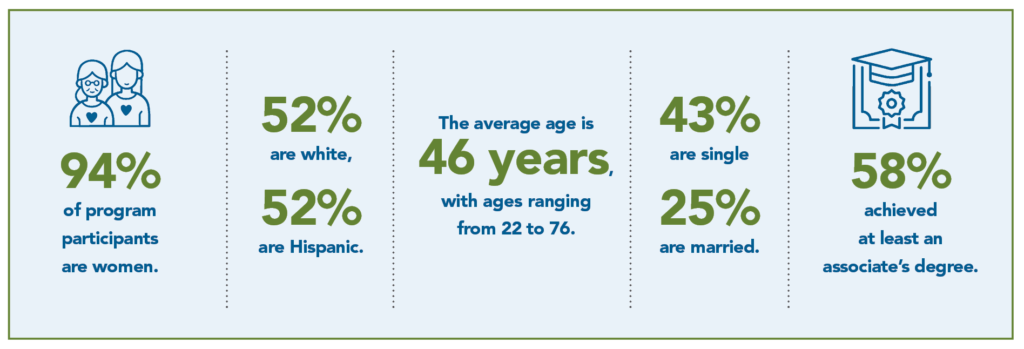
Demographics
Employment and Financial Situation
- 57% of program participants work full-time.
- 91% currently work as PCAs.
- On average, program participants have 13 years of experience as PCAs; experience ranges from 2 to 18 years.
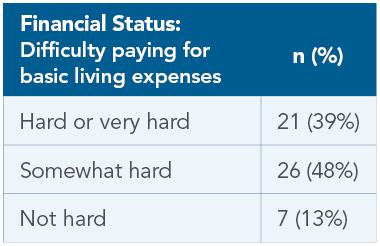
- 39% of program participants reported that it is “hard or very hard” to afford basic living expenses, including food, housing, and medical care.
Why did PCAs Participate in the Training Program?
 To gain or refresh skills and knowledge in caregiving and in specific conditions, including dementia and Parkinson’s disease, so they can better support care recipients.
- To help maintain care recipients’ independence at home.
- To receive financial incentives, including a stipend. Respondents rated the stipend’s importance an average of 4.4 out of 5. However, 82% reported they would have participated in the training even without the stipend.
- To enjoy continued learning.
- To connect with other PCAs.
“I know how to take care of my mother,” said one PCA who is a family member of their care recipient. “But … what if this is a bigger thing than just me taking care of my mother? I need to know more about how to take care of an older woman, (including) emergency preparedness, dementia, and mental health first aid. These are all things that I know nothing about, yet I’m responsible for her. So, I needed … training that (I) really didn’t even know I needed.”
How do PCAs Rate the Program?
- 91% reported being satisfied or very satisfied with the training program instructors.
- 85% found the online training platform easy or very easy to use.
- 72% reported that the workshop fit easily into their schedules.
- The topics most frequently identified as relevant and helpful were Adult First Aid/CPR/AED, Nutrition and Diabetes, and Communication and Boundary Setting.
What was the Program’s Impact?
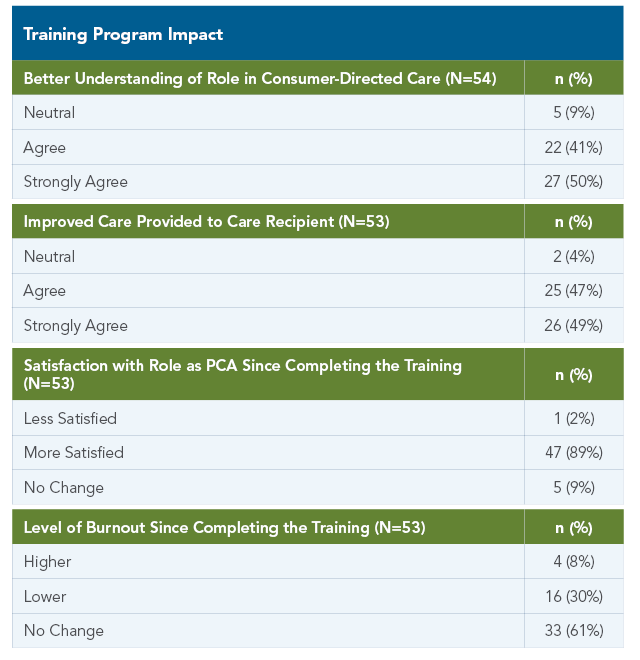
- 91% of PCAs reported gaining a clearer understanding of their role in consumer-directed care.
- 87% reported greater satisfaction with their role as a PCA.
- 61% reported no change in their burnout symptoms since completing the training.
- 96% agreed or strongly agreed that the training improved the care they provide to their care recipient.
On average, program participants rated their confidence in their caregiving skills as 4.1 out of 5 after completing the core and elective workshops. Confidence in skills learned in the core workshops ranged from 4.1 to 4.2, while confidence in skills gained in the elective workshops ranged from 3.8 to 4.4.
“It definitely did help because now I know how to do CPR and also how to safely manage medications. And I was also in the Alzheimer’s and dementia course. I didn’t know anything about that, so that was really helpful. (I have) the knowledge about the diabetes management and, if she (care recipient) ever got an infection, how to control that, and if she ever ends up choking, I know how to handle those situations.”
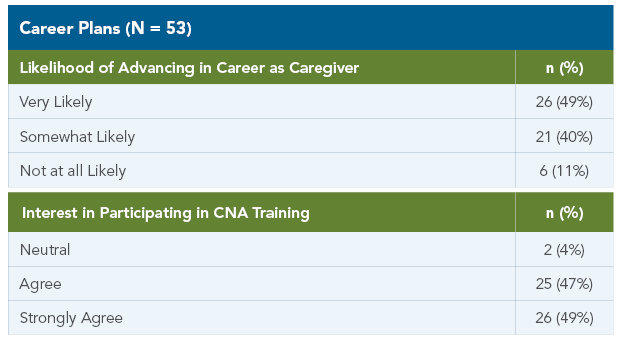
How do PCAs Describe their Career Plans?
- 67% indicated they are unlikely to leave their job in the next year.
- 49% said they are very likely to advance their career as a caregiver, for example, by becoming a home health aide or a certified nursing assistant.
- 78% said they are at least somewhat interested in training to become a certified nursing assistant.
What Did PCAs Say about the Training Program?
 Most of the 11 PCAs interviewed spoke positively about the training program. Interviews revealed that the program:
- Improved PCAs’ knowledge of caregiving practices and provided practical strategies for use at work (n=8).
- Featured effective facilitators who were knowledgeable and competent, and who explained training materials clearly (n=6) while creating an interactive environment that encouraged peer learning through questions and the sharing of real-world examples (n=7).
- Increased PCAs’ confidence in their caregiving role, including feeling better supported when managing challenging situations and when caring for the consumers they serve (n=4).
- Helped PCAs apply strategies, including redirecting care recipients living with dementia, setting clear boundaries with care recipients, adjusting meal plans, and managing blood sugar levels for care recipients with diabetes (n=8).
Participants shared the following thoughts about the program:
Perception of Facilitators:
“They were very pleasant. They gave plenty of time for questioning, and there was some affirmation. … A lot of people spoke, and they loved that. It was very interactive. They took their time. You didn’t feel rushed. If there was a question, they would stop and answer the question. If anyone had anything to add, they would allow that. And I thought that was very good.”
Application of Learning:
“As they (facilitators) were talking, I would take notes, and then go back and practice anything that I didn’t know, any new thing that I learned, and put it into practice. You know, infection control, diabetes, medication, Alzheimer’s and dementia, patient emergency preparedness, and medication safety.“
Relevance of Topics:
“The boundary and the resiliency (topics were most helpful) because when you’re working with someone who’s your family, you tend to forget you need to have these established boundaries. You’ve got to understand that, yeah, she’s your mom, but also you’re taking care of her. … You can’t forget you are a caregiver. You’re not just her child.“
About the Project Partners
About the 1199SEIU Training and Employment Funds, Massachusetts Fund
The Massachusetts Training and Employment Funds is a negotiated benefit between multiple healthcare employers and 1199SEIU covering 56,000 employees. The Fund provides thousands of healthcare workers throughout Massachusetts with career and educational advising, adult education, skills enhancement programs, tuition assistance, and professional development opportunities.
For more information, visit 1199seiubenefits.org/mass.
About the LTSS Center
The LeadingAge LTSS Center @UMass Boston conducts research to help our nation address the challenges and seize the opportunities associated with a growing older population. LeadingAge and the University of Massachusetts Boston established the LTSS Center in 2017. We strive to conduct studies and evaluations that will serve as a foundation for government and provider action to improve quality of care and quality of life for the most vulnerable older Americans. The LTSS Center maintains offices in Washington, DC and Boston, MA.
For more information, continue exploring LTSSCenter.org.
Contributors
Natasha Bryant
Senior Director of Workforce & Development, LeadingAge LTSS Center @UMass Boston