
Francesca Falzarano’s life experiences have helped shape her research and her role as an advocate for dementia caregivers.
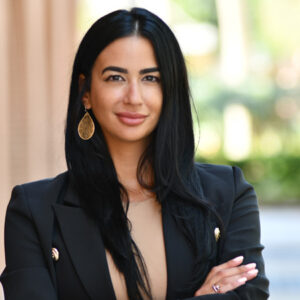 As a 14-year-old girl growing up in New York City, Francesca Falzarano should have been laser-focused on all the typical passions of teenagers: making friends, staying current with fashion and music trends, and catching the eye of that cute boy in her eighth-grade class.
Instead, the young Falzarano could think of nothing but her mother’s recent diagnosis of early-onset dementia. Seemingly overnight, that diagnosis thrust Falzarano and her family into caregiving roles for which they were unprepared and unsupported—and which, she admits, “robbed me of my childhood.”
Today, Falzarano is a developmental psychologist, researcher, and assistant professor of gerontology at the University of Southern California (USC). She is also part of the first cohort of a Fellows Program established this year by the LeadingAge LTSS Center @UMass Boston.
The LTSS Center Fellows Program aims to recognize individuals who work closely with the center in unpaid advisory roles. Its mission is to help the LTSS Center expand collaborative opportunities for research, publications, projects, funding, and influence.
Falzarano’s role as a family caregiver for her mother—and later for her father—lasted into her adult years and profoundly influenced her work as an educator, researcher, and advocate. Her goal is to frame dementia as a “disease of the family,” to serve as a voice for dementia caregivers, and to explore new ways to address caregiving needs that often change dramatically as dementia progresses.
Identifying Barriers to Service Utilization
Technology has played a crucial role in Falzarano’s caregiving research. She and her team at USC regularly evaluate technology solutions that could help caregivers find support after a diagnosis, when healthcare providers typically offer little guidance on available services. Unsurprisingly, these caregivers have shown a strong interest in using technology tools that would provide that support.
“I’ve had caregivers tell me over and over again that the most attention they get from the healthcare system is during the path to the dementia diagnosis,” says Falzarano. “And then, once you have a diagnosis, you’re left on your own. That’s exactly what happened to us. I still remember when my mother’s doctor told us, ‘There’s nothing more I can do for you, so just check in with your personal care physician in a year.’”
Ironically, this lack of guidance from medical professionals stems from a lack of knowledge rather than a lack of services, says Falzarano.
“The services are becoming increasingly more prevalent,” she says. “But doctors aren’t trained on what services are out there. It’s a huge disconnect.”
Falzarano believes emerging technology tools can help fix this disconnect.
“I’m interested in discovering how we can leverage technology to match the right caregiver with the right service at the right time based on their specific needs and disease trajectory,” she says.
The most useful technology will be designed with input from users, many of whom are older adults. That’s where Falzarano and her research team come in. For example, they are now testing a mobile app that uses artificial intelligence to assess caregiver needs and then provide tailored referrals. (Read more about this study.)
Falzarano says she could have used this kind of technology years ago.
“After my dad got sick, I was caregiver to both of my parents,” she says. “I had all the credentials in the world, but I was lost. So, I said to myself, ‘Netflix knows exactly what I want to watch. Amazon has no problem telling me all the things that I should buy. Why don’t we have anything to help us navigate services and supports for family caregivers?’”
The Power of Advocacy
Falzarano views research as crucial to driving change. But she also believes in the power of advocacy.
For example, she’d like healthcare providers to regularly evaluate both the person with dementia and their caregivers. She wants all providers to take responsibility for educating caregivers about services that can help them navigate the dementia journey. She also wants to focus more attention on ways to help young people in caregiving families.
“There is nothing about what I do that is not shaped by my experience with dementia,” she says. “People think advocacy calls for very big, grand gestures, but the movement starts with the smallest steps. Telling my story—informing and educating—is a kind of advocacy. Any step forward, however tiny, is still a step.”
LTSS Center Fellowship
Falzarano believes her LTSS Center fellowship will help her expand her work and collaborate more closely with aging services providers.
“The LTSS Center is very unique because it has broken down that silo between research and practice,” she says. “I’m looking forward to working with providers to co-create interventions and innovations for caregivers in real-world settings. I think this fellowship can really help me build the skills I need to translate my research into practice.”