
By Geralyn Magan
Jennifer Reckrey draws on her medical expertise and her passion for research to think deeply about how to make home care “better.”
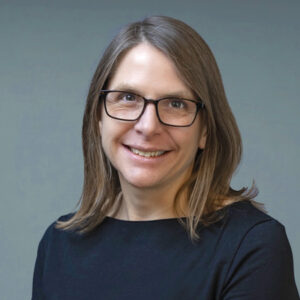 Jennifer M. Reckrey, MD, is on a mission to help older adults—particularly those living with dementia—remain at home and receive high-quality services and supports, if that’s their preference.
But don’t expect Reckrey to design a flashy new intervention to achieve that outcome. Nor is the practicing geriatrician and health services researcher focused on developing entirely new approaches to addressing the challenges faced by older care recipients, their families, and professional caregivers.
Instead, Reckrey says she’ll be satisfied with meeting a more realistic goal.
“When somebody has dementia or is getting closer to the end of life, there’s no changing that reality,” she says. “But if supports are in place and aligned with what the care recipient wants, we can make the situation better. That’s what I’m most interested in figuring out: how to make it better.”
To achieve that goal, Reckrey focuses her research on several clear objectives: identifying promising approaches already in use; documenting how and why those approaches work—or don’t work; and disseminating that information to providers so they can identify better ways to support care recipients.
Reckrey is a Clinical Professor in the Division of Geriatric Medicine and Palliative Care at New York University’s Grossman School of Medicine and a primary care physician at the Bellevue Geriatric Medicine Clinic. Juggling a career that combines primary care and research can be challenging, of course. Still, Reckrey’s dual specialties have given her valuable opportunities each day to step back, pay attention to the care-access challenges she’s witnessed in her medical practice, and use the research process to think more deeply about how to change the status quo.
Along the way, she has committed to exploring three areas she believes can improve the home-care environment: a renewed focus on supporting direct care professionals, a deliberate effort to foster coordination and integration across the health and long-term care sectors, and a concerted effort to generate reliable data to help define what success might look like.
Supporting Direct Care Professionals
After completing her medical training, Reckrey practiced home-based primary care, visiting and caring for people with advanced illnesses in their final years. That experience deepened her appreciation for the direct care professionals who support older people with dementia at home. It also strengthened her commitment to using her research to strengthen that workforce and ensure that aides receive the tools they need and the respect they deserve.
“The clinical care I provided in the home was absolutely essential,” she says. “But the only reason I could do my work was that someone was there providing day-to-day care, either a family member or an aide. I think you do a real disservice to care recipients if you disconnect their clinical needs from their other day-to-day support needs. I hope to ensure that clinical care providers acknowledge and practice in ways that make clear how important that day-to-day care is and how it makes other care possible.”
Fostering Coordination and Integration
The importance of the aide’s work underscores the need to bring the worlds of primary and long-term care together to support the care recipient, says Reckrey. That integration should touch every aspect of care, making it easier for direct care professionals to communicate meaningfully and effectively with family members and to connect with the clinical care team about problems or questions. It should also ensure that primary care teams understand the home environment’s important role in preserving the care recipient’s well-being.
Right now, these worlds seem far apart, she says.
“Generally, the team in the intensive care unit isn’t thinking about what it will look like when this person goes home after a hospital stay,” she says. “They won’t let you leave the hospital without a doctor’s appointment. That’s awesome. Sometimes they even hand you your medications so you don’t have to go to the pharmacy. But they don’t ask you who’s going to help you get out of bed, onto the toilet, and what will happen if you fall. That part is somebody else’s business.”
That mentality has to shift, says Reckrey.
“The doctor at the hospital is certainly not going to hire your home health aide,” she says. “But they should know if you have an unmet need for home care so they can bring in a more interdisciplinary team to get you the care that you need.”
Generating Reliable Data
As a researcher, Reckrey understands the important role data plays in showing providers what works, what doesn’t, and why. Collecting reliable data sometimes means asking simple questions you think you already know the answer to, she says. For example, Reckrey and her research colleagues hope to begin documenting whether consistently assigning home care aides to the same care recipient improves health outcomes.
“We want to know whether the quality of home care affects patient outcomes,” she says. “If continuity matters, then it’s worth changing the system to promote continuity and a good match between the aide and the person receiving care .”
The role of research is to demonstrate that benefit, even if it seems obvious, says Reckrey.
“Some of this is intuitive, but we need to be able to put our fingers on the factors that show it’s working,” she says. “If you can’t quantify it at all, then you can’t identify what makes it work or what is transferable to other situations. Good data really is necessary to make those connections and motivate people to come up with creative answers or elevate the approaches that seem to be working better.”
Working with LeadingAge Members
Reckrey says she looks forward to working with LeadingAge members to provide data-driven answers to any additional questions they may have about the benefits of different care approaches.
“I’m interested in the lived experience of being at home with dementia when things are hard,” she says. “I’m also interested in the lived experience of home care agencies that are committed to delivering quality care. What are the problems? How can we generate data so people can see opportunities they couldn’t see before, or see shared challenges in a way that makes them easier to solve?”
“We’re all struggling with the same challenges,” continues Reckrey. “We’re all interested in describing and understanding those challenges and making things better.”