By Jennifer M. McGivney
Older humans and older penguins have more in common than you might think. Here are five lessons these flightless seabirds can teach us about aging well in community.
In Boston, there’s an older adult community unlike any other. Here, residents have access to age-appropriate healthcare and transportation to their checkups and procedures. They enjoy lifelong learning alongside friends. Ramps and accommodations help residents with disabilities navigate the community safely. The dining menu prioritizes healthy eating, with a particular fondness for fish.
This age-friendly community is in the New England Aquarium, and its residents are African penguins. The aquarium has a dedicated island for geriatric penguins, providing the healthcare, accessibility, social connections, and enrichment that aging penguins need to thrive.
These features are remarkably similar to what we humans need to thrive as we age.
The New England Aquarium’s penguin retirement home is a beautiful example of an age-friendly community—and one that can spark important conversations about the elements that make such communities so effective.
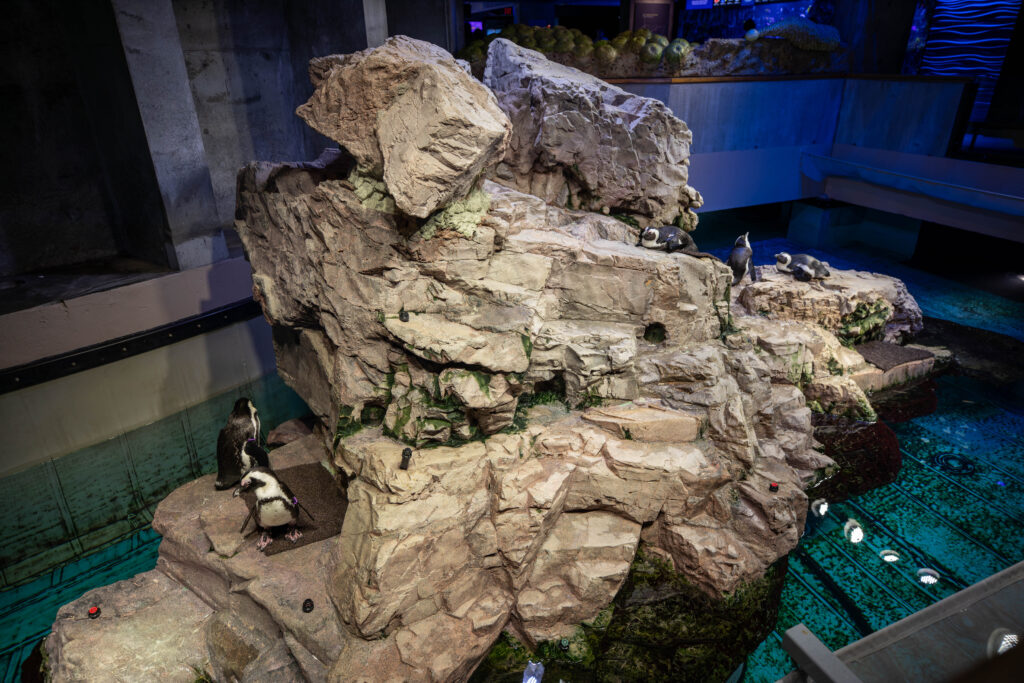
The penguin retirement home is a favorite among New England Aquarium visitors. Photo courtesy of the New England Aquarium.
“It shows that all of those social determinants of health matter for penguins, too, like stress, environment, healthcare, quality of life,” says Michelle Putnam, director of the Gerontology Institute at UMass Boston. “With this penguin retirement home, the New England Aquarium is doing something very age-friendly and doing it very well.”
The results are impressive. While penguins in the wild typically live for 10 to 15 years, the New England Aquarium has five penguins who are already in their thirties.
“We’re learning incredible things from the penguins,” says Kristen McMahon, the aquarium’s curator of pinnipeds and penguins. “Longevity gives us the ability to learn so much about their husbandry and health care. We’re very connected to each individual penguin, and we want to give them the best care, every single day.”
Here are five lessons that the flightless birds can teach us about aging in community:
1. Friendships and community are important forms of medicine.
When Lambert, a 34-year-old penguin, entered the aquarium’s penguin retirement home, his 16-year-old mate, Dyer, went along with him.
“We want them to be with their mates,” McMahon says. “We want them to be socially content.”
Being socially content is, of course, crucial for humans as well—not just emotionally, but also physically and cognitively.
“Research consistently shows that social connection supports physical health, cognitive function, and emotional well-being, while prolonged isolation is associated with increased risks of depression, cardiovascular disease, cognitive decline, and even premature mortality,” says Caitlin Coyle, director of the Center for Social & Demographic Research on Aging (CSDRA). “Creating places where older adults can spend time with peers, build relationships, and simply enjoy being together isn’t just a nice amenity—it’s an investment in healthy aging and longevity.”
To help communities reduce loneliness and strengthen social connections through age-friendly programs, CSDRA co-founded the Massachusetts Coalition to End Loneliness & Build Community. The goal—for both penguins and humans—is to help others build healthier, more socially connected lives.
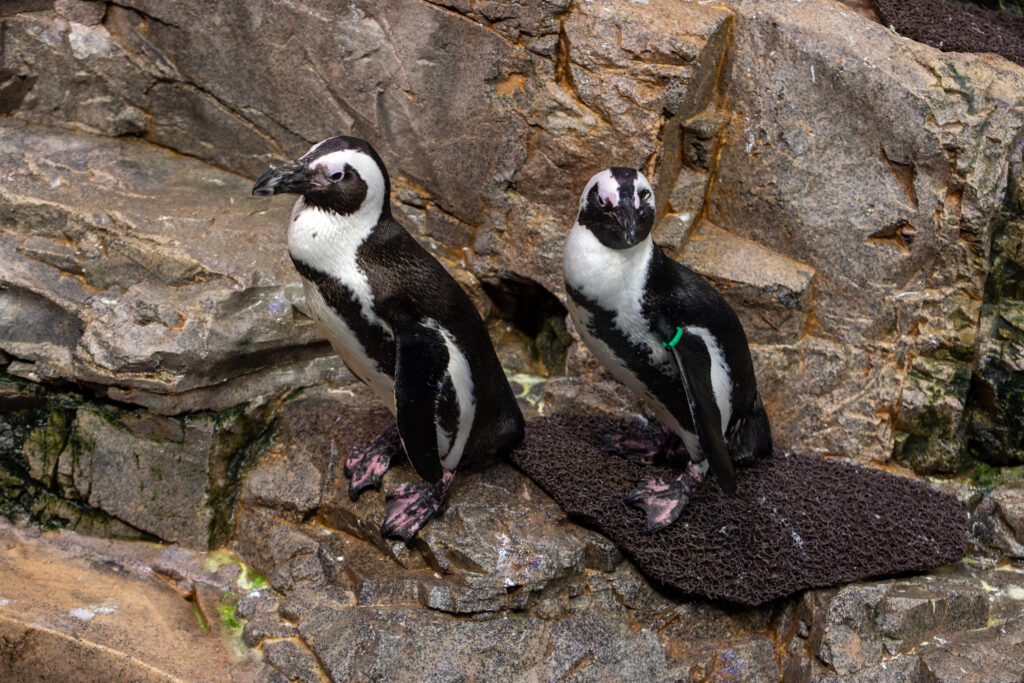
Lambert, right, is a 34-year-old penguin who lives at the New England Aquarium’s penguin retirement home. Photos courtesy of the New England Aquarium.
2. Learning offers crucial cognitive and social benefits throughout the lifespan.
The aquarium’s older penguins need no encouragement to be lifelong learners. They naturally excel at exploration and play.
Throughout the day, the aquarium provides the penguins with access to interactive devices that create enrichment opportunities: devices that mimic a natural kelp bed for the penguins to explore, devices paired with fish that allow them to forage, and even devices that sink or swim through the water to encourage exercise. The penguins even take field trips when the aquarium is closed to the public, with staff leading them on walks to explore other areas of the building.
“Enrichment is an important part of their world, for penguins out in the ocean and in here,” McMahon says. “We want them to play, exercise, forage, explore. All of that activity is very stimulating for them both mentally and physically.”
Lifelong learning helps older adults thrive, too. The Osher Lifelong Learning Institute (OLLI) at UMass Boston offers classes and programs for adults 50 and older. Research shows that the mental stimulation and social interaction these classes provide improve emotional and cognitive health in older adults.
“Our courses help stimulate the brain by learning new knowledge and satisfying that curiosity itch,” says OLLI Director James Hermelbracht. “Our walking group gets members moving while also socializing with one another. Our knitting and painting classes encourage learning new skills by engaging the hands and eyes. We know that lifelong learning programs positively impact older adults by lessening loneliness and maintaining an active mind.”
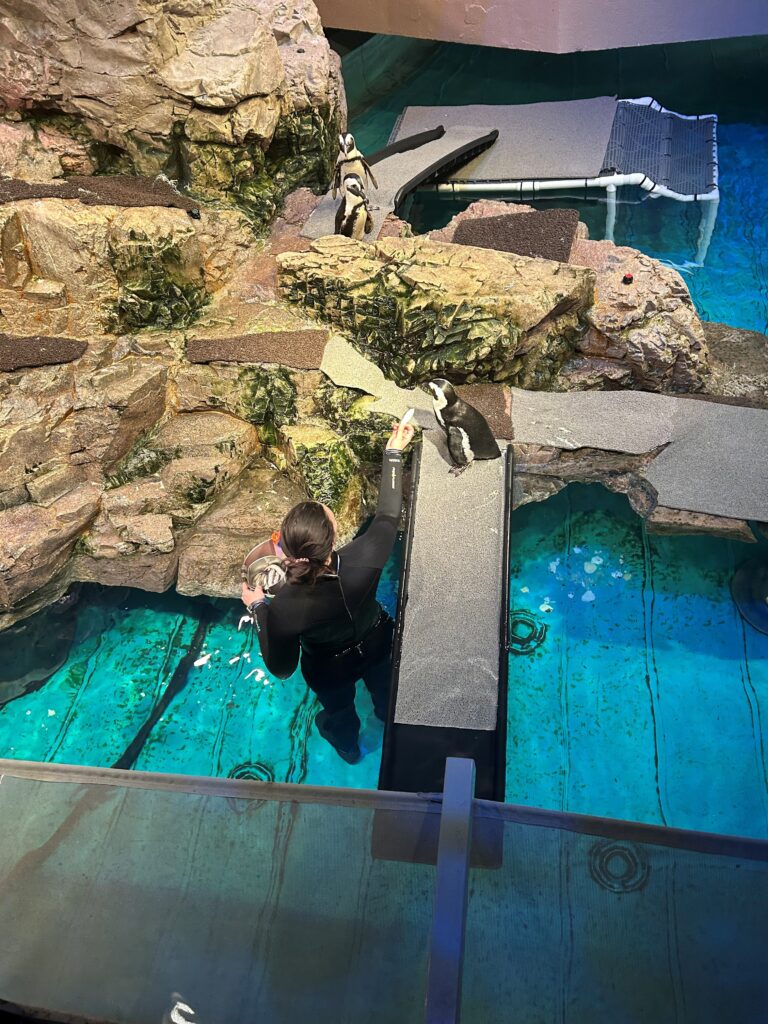
Penguins with mobility issues can use ramps to get in and out of the water easily. Photo courtesy of the New England Aquarium.
3. “Aging well” doesn’t mean avoiding disabilities or health challenges, but it does require access to needed accommodations.
Several penguins in the aquarium’s penguin retirement home have health issues, disabilities, and mobility challenges. To help them maneuver, the island features several ground coverings, including pebbly rocks and soft mats, so penguins can choose the texture that best helps them navigate their surroundings. The island also has ramps to help penguins move easily in and out of the water.
“These geriatric penguins now have easier access to swim and navigate up onto the island,” McMahon says. “They utilize these access points often and with ease.”
The penguin retirement home also helps Lambert—who needed surgery to remove an eye—navigate his surroundings with a visual impairment.
“Lambert has less visibility, but he’s so adaptable in this environment and so comfortable here because he doesn’t have as many of his same species in a smaller space,” McMahon says. “Having a little more space and being able to navigate the island without territorial disputes allows him to adapt well while having limited vision … It’s surprising to see him thriving at his age with limited vision. It’s exciting.”
Age-friendly communities also include inclusive, accessible features. By creating accommodations—such as benches that let people rest in a store or wide doorways that let wheelchair users pass through—older adults with disabilities can navigate their communities more easily.
“Disability is a fundamental mismatch between the abilities of an individual and the demands of their environment,” Putnam says. “It’s a simple equation. If you can modify an environment to match any person’s abilities, you make it possible for people to do what they want to do—to be who they want to be and to age well.”
4. Transportation is more than getting where you need to go. It’s getting what you need to thrive.
The older penguins at the New England Aquarium have a dedicated healthcare team. Each penguin receives regular physicals, eye exams, mobility screenings, and foot care. Some also receive additional care, such as acupuncture, physical therapy, X-rays, or cataract surgeries, as needed. This requires aquarium staff to transport penguins to appointments within the same building or at regional veterinary clinics.
The healthcare team has taught the penguins to walk into transport kennels, stand on scales, and participate in their care. Because the penguins are comfortable with their human caretakers, the caretakers can take them to the medical appointments they need to stay well.
Transportation is also critical for the health of older humans.
“Just like the aquarium makes sure an older penguin can get where it needs to go for care and enrichment, we need to ensure older adults have reliable transportation,” says Rebecca Tolman, director of the Management of Aging Services program at UMass Boston.
“Transportation is one of the keys to healthy aging,” she continues. “It connects people to healthcare, social opportunities, and the communities they love. Without it, older adults may miss medical appointments, become isolated, and struggle to remain healthy and independent, especially in rural states. Whether you’re a retired penguin or a retired person, everyone deserves a way to get where they need to go!”
Finding commonalities—and inspiration—across species.
The New England Aquarium’s work has caught the attention of older adults, who visit to see how penguins are adapting to retirement. They’re surprised to learn that older penguins sometimes need some of the same things they do, whether it’s a particular medicine, supplement, or type of physical therapy.
“It really translates,” McMahon says.
As the elder penguins at the New England Aquarium enter their mid-thirties, they demonstrate the benefits of growing older in an age-friendly community. Age-friendly communities offer people the same opportunity: to continue living the life they enjoy, with the support, intentionality, enrichment, and accommodations they need.
“These penguins just want to keep being penguins,” Putnam says. “They want to keep doing what they were doing before.”
Read the original story in the Gerontology Institute blog: Lessons in Aging from a Penguin Retirement Home.