By Geralyn Magan
Carey Candrian will take a unique approach to ensuring that LeadingAge research and programs are designed to improve the lives of older adults, meet member needs, and drive policy change.
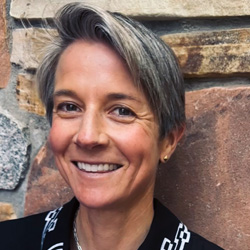 Several years ago, Carey Candrian and an academic colleague developed a training program to help an assisted living community in Colorado become more inclusive of residents and staff who identified as LGBTQ. The project faltered after Candrian tried to explain to the community’s staff and residents why the training was important.
“I shared every statistic I knew about how hard it is for LGBTQ people in assisted living,” recalls Candrian, LeadingAge’s new senior vice president of research and programs. “I told them that 75% of LGBTQ older adults go back into the closet after moving to assisted living; that 48% haven’t come out to their own doctor; and that the stress of living with chronic stigma and discrimination can take up to 12 years off your life.”
Candrian quickly realized she faced a challenge more basic than she had anticipated: her audience couldn’t connect her shocking statistics to real people.
“They didn’t think they knew anyone who was LGBTQ,” she says. “I drove away, telling myself I needed a new strategy.”
That new strategy transformed Candrian’s research agenda and crystallized her thinking about the importance of telling the personal, often heart-breaking stories of older adults affected by all kinds of disparities—whether those disparities are rooted in sexual orientation, ethnicity, socioeconomic status, disability, or age.
She also committed to engaging the people closest to the issues affecting older adults—including assisted living residents, hospice patients, Medicaid beneficiaries, people living with dementia, and caregivers—in designing her research. Finally, she became passionate about disseminating that research so it is accessible to diverse audiences and can drive needed change.
Candrian plans to pursue all these goals at LeadingAge.
“I want to engage LeadingAge members in LeadingAge research and programs,” she says. “I want members to drive the research we conduct and the programs we develop so they are actionable and relevant. I’m eager to help us think in new ways about how research and programs can best help the people we serve, meet member needs, and educate policymakers.”
Connecting Data with Stories of Real People
Candrian’s first foray into this new research approach was “Eye to Eye,” an exhibit of photographs and accompanying quotes featuring 31 older LGBTQ women she had interviewed for a separate research project. The exhibit debuted at the University of Colorado School of Medicine, where Candrian served on the faculty for 14 years. Since 2022, it has traveled to a range of venues, including art galleries, churches, libraries, and the Denver Airport. Regional and national media, including PBS and USA Today, have covered the exhibit.
“This was a profound learning experience for me,” says Candrian. “I’ve been doing research for years, and nothing I’ve done has received this kind of attention. People have read some of my academic articles, but hundreds have seen this exhibit. And hundreds more have read articles and seen stories about the exhibit and these older women. Stories of hope, beauty, and courage; stories that humanize older LGBTQ people.”
The success of Eye to Eye led Candrian to focus on an approach that has become her passion: linking data to the stories of real people. During a yearlong Capitol Hill fellowship with the Committee on Ways and Means Subcommittee on Health, she put her unique blend of research and storytelling into practice.
“They were excited about the communication and messaging aspects of my research,” says Candrian, referring to the committee staff. “They obviously rely on research to make big decisions, but they don’t have time to read academic journal articles. That experience convinced me we need to do a better job of giving policymakers the information they need in a form they can easily understand and use. Numbers are harder for people to connect with, which is why the committee staff kept asking me to uncover and retell stories of real people facing real challenges. It’s harder to look away when you see or hear a person.”
Trained to Listen and Observe
Candrian is trained as an ethnographer—a researcher who studies people, cultures, and communities by observing and participating in their daily lives.
“As part of my early research, I volunteered at a hospice in Denver and pushed this hospitality cart to each room,” she recalls. “I saw how hard it was for so many people to speak up for themselves, and how much harder it was for older adults, especially those coming from behind. I was determined to change that.”
After earning her master’s degree in organizational communication, Candrian studied the cultures of organizations providing assisted living and hospice services, including the language they used to sustain those cultures and the effects those cultures had on workers and on care quality. A doctoral degree in health communication helped her expand her exploration.
“Technically, I’m a social scientist,” she says. “For me, that’s always meant focusing on the social aspects of health and aging, including support systems, food insecurity, financial insecurity, housing insecurity, stigma, bias, and discrimination. All of these social factors profoundly affect a person’s health and life; understanding their impact requires deep listening.”
For example, Candrian says it’s important to listen to how broader discussions and narratives about aging, the workforce, Medicaid, and housing shape how people think and feel about the groups most affected by these issues. In addition, she says, it’s especially important to listen to those affected by health and economic disparities, whether they are older adults or caregivers. These people have traditionally been excluded from conversations about the challenges they face, yet they hold the key to finding solutions.
“We haven’t done enough to involve older adults or those providing direct care in our research, and it has been a significant loss,” says Candrian. “We can’t address the challenges facing the aging population without truly seeing and hearing older adults and those who care for them. We have to engage with the people closest to the issues we study, especially those who have been historically undervalued or stigmatized for a variety of reasons. If we don’t, we’ll never be able to make the changes we most need.”